|
|||||||
|
|
Horse Heaven Hills
Horse Heaven Hills is
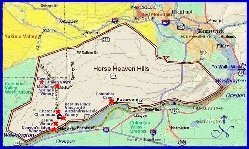
defined by natural boundaries... on the north by the Yakima Valley
appellation and on the south by the
The hills are geologic folds in the earth's crust which account for the consistent winds that blow across the land, lowering the risk of vineyard disease and pests. These continual winds stress the vines of vineyards across the region, drying them out and setting the stage for drip irrigation to be used as a canopy management tool to limit the plants' vigor. All these factors lead to intense-flavored grapes with a structural balance of sugars and acids.
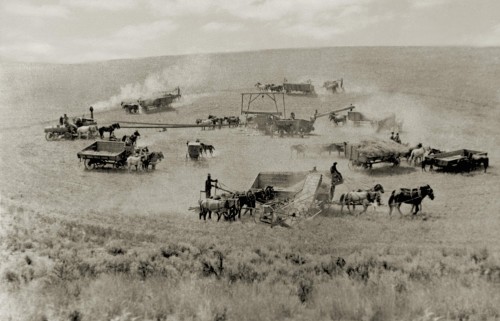
The quick-draining soils of silty loam in the Horse Heaven Hills region were deposited approximately 15,000 years ago by the great Missoula Floods that repeatedly dropped their loads of silt over the rocky volcanic base of fractured basalt in the area. The quick-draining nature of the soil and the area's semi-arid climate allow growers to manage their vineyard canopies through drip irrigation. Today's grape growers are not the first farmers to understand the benefits of these sloping lands above the mighty Columbia River. Dry-land wheat farming and other early 20th-century irrigated agriculture thrived on these hills. The gentle, largely south-facing slopes of the area were recognized as a natural drainage basin for sub-freezing air conditions.
The land of Horse Heaven Hills is bone dry... hotter and windier than the Yakima Valley appellation to the north, but winters are somewhat milder thanks to the nearby river. Elevations range from 1,800 feet at the area's northern boundary to 200 feet at its southern boundary along the Columbia River, which also marks its eastern boundary. The west boundary is formed by Pine Creek (which flows south to the Columbia River) and the 1,700-foot contour line. Currently, six wineries call Horse Heaven Hills home, along with approximately two dozen growers, including the state’s largest (owned by Ste Michelle Estate Wines) and some of its longest-established vineyards (Champoux Vineyards, formerly Mercer Ranch Vineyards, planted in 1972). Viticulturalists find that a predictable drop in October temperatures keeps grapes on their vines a little longer than other areas, allowing full ripening and fuller-flavors in their grapes. With 15,534 acres currently planted (as of end of 2017), Horse Heaven Hills AVA is home to 26% of Washington's vineyard acreage. Premium wineries located elsewhere also use Horse Heaven Hills grapes. Some of those wineries include: Andrew Will, Betz Family Winery, Januik Winery, L'Ecole Nº 41, O S (formerly Owen-Sullivan), Soos Creek, Three Rivers, Quilceda Creek Vintners, Woodward Canyon and Washington wineries of Ste Michelle Wine Estates (Col Solare, Columbia Crest, Chateau Ste Michelle and Northstar). The Horse Heaven Hills area was designated as its own American Viticultural Area (AVA) in 2005, distinguishing it as distinct from the massive Columbia Valley AVA that surrounds it. The Horse Heaven Hills AVA encompasses 570,000 acres (approximately 16,000 in production) on a wedge of land that starts on the 1,800-foot ridges of the Hills and slopes south to the Columbia River. Resident Wineries & Tasting Rooms of Horse Heaven Hills
For complete contact information, see our Washington Winery Finder
Copyright © 2005 -
October, 2019 Susan R. O'Hara. All rights reserved. |
||||||



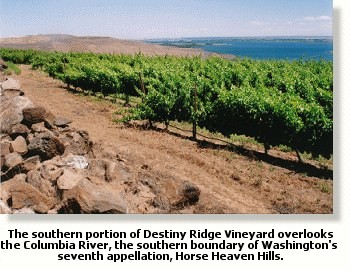 Columbia
River.
It
Columbia
River.
It