|

Winery &
Merchant
Finder





|
British Columbia
Wineries,
Wine Country
and
Wines
|
The dramatic beauty of the
Pacific Northwest is legendary.
Leading roles in this natural drama are played by verdant
coastal ranges and the rugged Cascade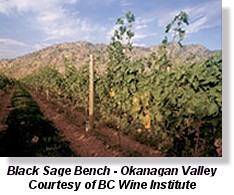 Mountains, projecting beauty and inspiration across its regional stage.
Geologic histories assume equally major roles in regional weather
systems -- roles that determine the varieties and success of
wine-grape growing throughout Pacific Northwest wine regions.
British Columbia Wine Country is no exception.
Without prejudice of national or political boundaries, the spectacular
Cascade Mountains rise to high elevations throughout Oregon, Washington
and southern BC. Elevations of more than 14,000 feet easily prevent
westerly flows of cooler, wetter weather systems from moving east.
While wine-country travelers in southwestern BC find wineries and
vineyards on both sides of the Cascades, many more are located to the
east of the Cascades taking advantage of the "rain shadow" affect that
creates substantially warmer and drier conditions for the
Similkameen and the Okanagan
wine regions.
To the west of the mountain range, wineries are scattered within five "Designated
Viticultural Areas" (DVAs)as of May 2014 -- the
Okanagan Valley, the
Similkameen Valley, the Vancouver Island, the Gulf Islands
and the
Fraser Valley, where the weather is mild and
relatively wet compared with the regions to the east.
Heading east from Vancouver or the Fraser Valley, first on Hwy 1 then
Hwy 3, you will travel through the northern reaches of the Cascade
Mountains, more commonly known as the Canadian Cascades. If you
take Hwy 3 at its junction with Hwy 1, you will pass through the
beautiful
Similkameen Valley and
transition from wetter to the drier side of the mountain barrier, as you
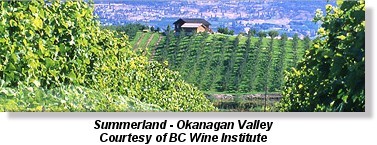
head southeast to Osoyoos and the southern Okanagan Valley - the driest,
largest and most popular DVA of British Columbia.
The Okanagan Valley DVA
begins in Canada's only true desert environment and is adjacent to the
U.S. border. Crossing the border to the south one notices that the
Valley continues, and although the terrain doesn't change, the spelling
of it does.
In the states
the Okanogan Valley is home to several additional wineries and
vineyards.
Within British Columbia, the Okanagan Valley DVA stretches 155 miles
north through a variety of microclimates, ending in an area that favors
cool-climate viticulture. Mid valley is the location of the
unofficial Naramata Bench wine region, which is entirely contained
within the viticultural area of the Okanagan Valley. Weather in
the Similkameen, the Okanagan and the Naramata Bench regions is more
extreme than that to the west of the Canadian Cascades.
Use our Winery & Merchant Finder to locate
addresses and
telephone numbers of specific British Columbia wineries.
Many different soil and weather variations in the Okanagan combine to
create ideal growing conditions for a wide variety of wine grapes.
This diversity makes it conceivable to visit neighboring vineyards in
the region that produce completely different wines. Located in
BC's south central interior, the
Okanagan and Similkameen Valleys are the oldest and largest
of this province's wine-producing areas -- both in size and in the
number of active wineries and vineyards.
Between BC's three official wine regions in the west and its major Okanagan and
Similkameen wine regions to the east, the traveler finds a wide
selection of varietal wines, primarily produced from French and German
vinifera grapes, from big, ripe reds to fresh, cool whites, and rich,
sweet Icewine made from grapes left to freeze naturally on the vine.
Approximately 30 years ago, government-sponsored, experimental vineyard
plots helped winemakers discover which varietals ripened properly and
survived in BC's consistently frosty winters. Since then, vineyard
managers and winemakers have made good use of the knowledge gained, and
have worked together to refine the art of viticulture in British
Columbia. Many international and regional awards attest to their
success.
|
|
Trademark wine products for the
Province are crisp, fruity white wines and scrumptious dessert
wines, including late harvest wines and Icewines (picked and
crushed while frozen). More and more red wine grapes are
being grown in the southern Okanagan and the Similkameen
Valleys, where the hot, desert climate and long,
northern-latitude growing season create microclimates well
suited for many red varietals. Cool nights in these warmer
areas prevent the breakdown of acids caused by constant heat.
Plantings of Cabernet Sauvignon, Cabernet Franc, Merlot and
Syrah,
among others, are now scattered throughout this southern area. Pinot noir is also widely planted in
British Columbia wine regions.
In the southern Okanagan Valley,
intense hot, dry summers, coupled with harsh, cold winters,
produce quality fruit for a variety of distinctive wines.
Touring British Columbia
Wine Regions
The
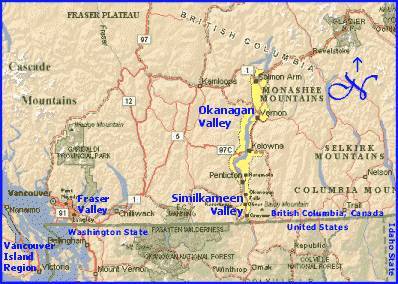
overview map and links below allow you to
explore the wineries operating in each of BC's Designated
Viticultural Areas. Watch for links to suggestions for
nearby lodging, dining, special events and touring opportunities
organized by region. Click on the region of your choice or the
map below.
 Okanagan Valley &
Similkameen
Valley
Okanagan Valley &
Similkameen
Valley
 Fraser Valley

 Vancouver Island
Gulf Islands

Copyright © 1999 -
October, 2019
Susan R. O'Hara. All rights reserved.
Last revised:
10/04/2019 |
British Columbia
Wine Facts-
-
Number of
Grape-Wine Wineries
2017 - 350+
2015 - 320
2014 - 273
2013 - 221
2012 - 206
2011 - 193
2008 - 148
2006 - 132
2005 - 120
2003 -
72
1999 - 63
1995 - 32
1990 - 17
1988 - 13
- Vineyard
Acreage
2015 - 10,260 acres
2014 - 9,867 acres
- 2010 - 9,500 acres
2008 - 7,500 acres
2006 - 5,462 acres
1999 - 4,200 acres
1994 - 2,149 acres
1989 - 1,000
acres
Number of
Vineyards
(Independent growers &
wineries)
2012 - 864 vineyards
- Grapes
Harvested
(approximate)
2013 - 31,500 tons
2012 - 30,100 tons
- Major
Varietals
- TOP 10 WHITES
Pinot Gris, Chardonnay, Gewürztraminer, Riesling,
Sauvignon Blanc, Pinot Blanc, Viognier, Ortega,
Ehrenfelser, Muscat
-
TOP 10 REDS
Merlot, Pinot Noir, Cabernet
Sauvignon, Syrah, Cabernet Franc, Gamay Noir, Maréchal Foch,
Malbec, Petit Verdot, Zweigelt
- Additional Varieties
Zinfandel, Pinotage, Tempranillo, Baco Noir, Pinot
Meunier, Sangiovese, Leon Millot, Chancellor,
Dunkelfelder, Agria, Castel, Carmenere, Grenache, Mourvedre, Bacchus,
Semillon, Auxerrois,
Siegerrebe, Vidal, Kerner, Schönburger, Chenin Blanc,
Madeleine Angevine, Müller Thurgau, Madeleine
Sylvaner, Optima, Chasselas, Roussanne
WINE STYLES
Icewine,
Late-Harvest,
Sparkling, Still & Fortified
Ratio of Red to White
52.09% to 47.91%
Wine Production
(litres, est.)
2012 - 17,717,200
2011 - 14,769,300
2010 - 11,555,700
2009 - 12,921,350
Wine Regions
"Designated Viticultural Areas"
Fraser Valley
Okanagan Valley
Similkameen Valley
Vancouver Island
Gulf Islands
Application pending for
the sub-appellation of the Golden Mile Bench in the Southern
Okanagan
Emerging Regions:
Thompson/Shuswap
The Kootenay
Lillooet
Last Updated
10/04/2019 |
|

